
Put 200 g of kibble next to 200 g of fresh food and they look like the same meal. They aren't: the kibble carries about 2.7 times the calories and a tenth of the water. That difference changes how full, hydrated and trim your dog stays.
We compared a popular grain-free fish & potato dry food with our own Momo&Co recipes. Here is what we found, in plain numbers.
Water: the ingredient kibble leaves out
Fresh meals are about 75% water; dry kibble is about 8%. That single difference shapes everything else in the bowl.
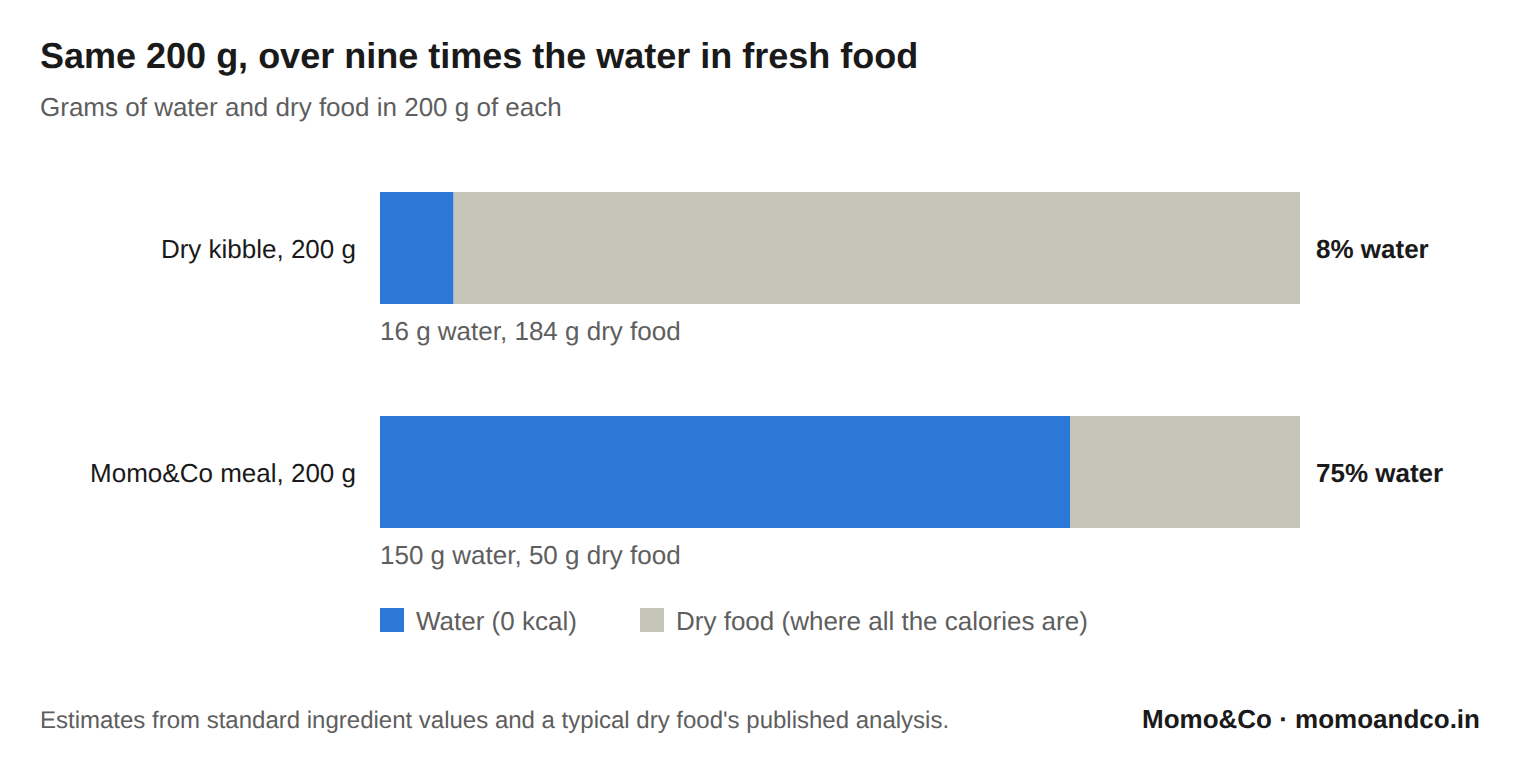
200 g of Momo&Co food gives your dog about 150 ml of water; 200 g of kibble gives about 16 ml. A kibble-fed dog has to drink that difference from the water bowl, and many don't. Good hydration supports kidney health, digestion and regular stools.
Calories: same weight, very different energy
Water has zero calories, so removing it concentrates energy. Gram for gram, kibble carries about three times the calories of fresh food: roughly 350 kcal per 100 g against 70–130 kcal for our recipes.
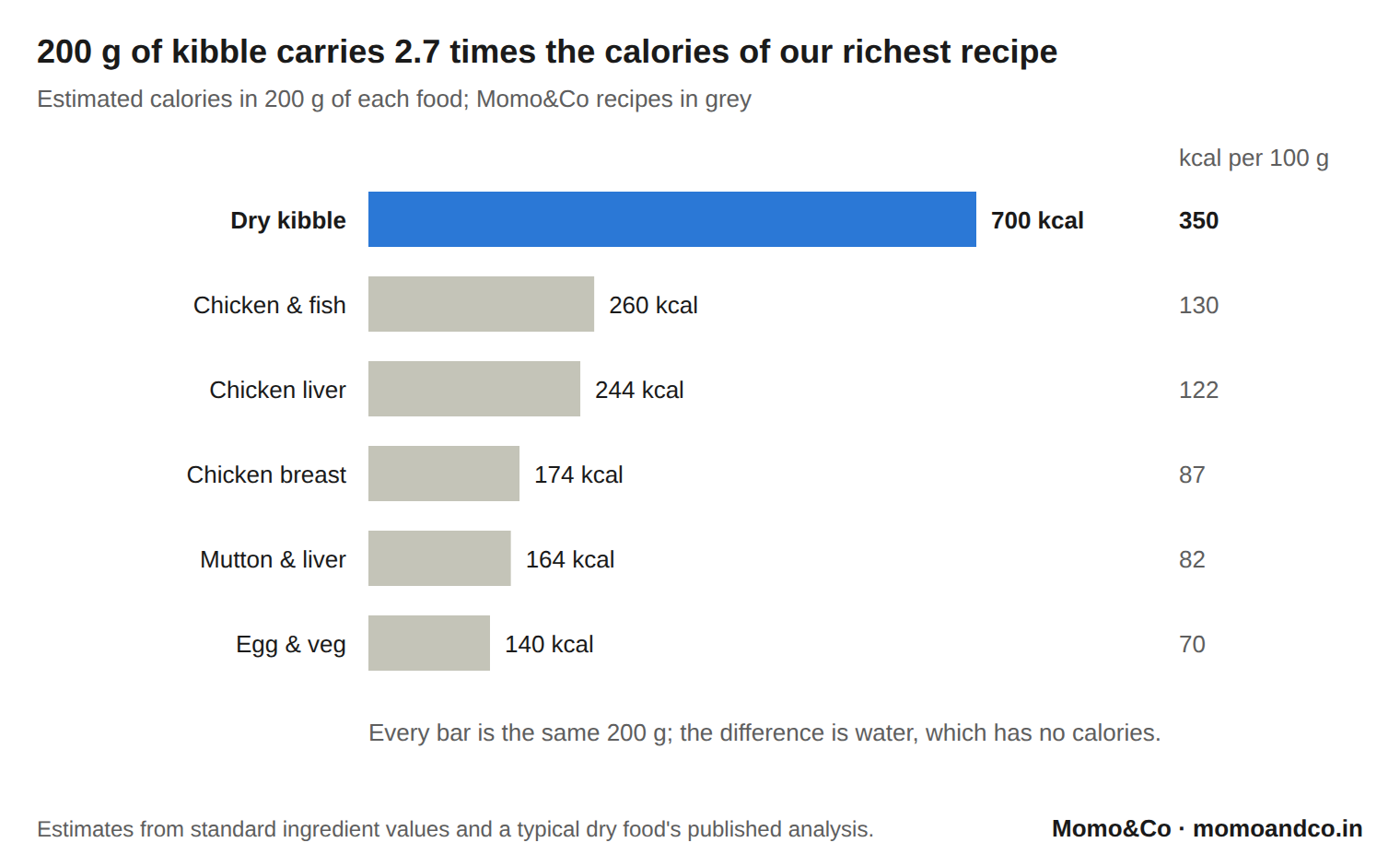
In practice, 200 g of kibble gives about 700 kcal, while 200 g of our richest recipe gives about 260 kcal. To match the kibble's energy, a dog would eat over 500 g of fresh food.
Why dry food makes weight gain easy
Calorie-dense food makes small mistakes expensive. An extra 20 g of kibble, barely a heaped spoon, adds about 70 kcal a day. Over a few months, that quiet surplus shows up on the scale.
Fresh food works the other way. Your dog eats a satisfying, full bowl for fewer calories, so it feels fed without overeating. That makes holding a healthy weight, or losing a little, much easier.
The same fact cuts both ways. A dog that needs to gain weight simply gets a slightly larger portion or a richer recipe, and we adjust that for you.
Carbs: a supporting role, not the base
Many grain-free dry foods are built on potato, often around half the recipe. At Momo&Co, starchy ingredients make up about 2.5% of what your dog eats across a month.
- White potato digests fast. It has a high glycaemic index, and the high-heat process that makes kibble speeds that up further.
- Sweet potato releases energy more slowly. It also brings fibre for the gut, beta-carotene (a source of vitamin A), vitamin C and potassium.
- Fibrous vegetables do the rest. Pumpkin, carrot, beans, cabbage and gourds add fibre, vitamins and variety without bulking up the bowl.
In a typical dry food, carbohydrates supply about 40% of the calories. In our sweet potato recipe, they supply about 16%; the rest comes from real protein and fat.
How Momo&Co builds a bowl
Every week your dog gets two recipes, one liver-based and one chicken & fish, and they change every week across a four-week cycle. That is eight different recipes a month.
- Real meat first: fresh chicken, liver, fish and mutton make up 55–60% of each recipe.
- Around ten vegetables a month: pumpkin, carrot, beans, cabbage, chow chow, bottle gourd, spinach, broccoli and more.
- Complex carbs in measure: sweet potato appears in our rotation for steady energy and fibre, never as filler.
- Kitchen spices, not additives: turmeric, black pepper, ginger, mint and amla.
- Cooked fresh: portioned to your dog's weight and delivered on your schedule.
Making the switch
Move over gradually across about a week so your dog's tummy can adjust.
- Days 1–2: a quarter fresh, three-quarters current food.
- Days 3–4: half and half.
- Days 5–6: three-quarters fresh.
- Day 7: fully fresh.
Weigh your dog before you start and every week after. Tell us how it's going, and we'll fine-tune the portion.
Ready to fill your dog's bowl with real food? Start at momoandco.in.
*Calorie and moisture figures are estimates from standard ingredient values and a typical grain-free dry food's published analysis. Every dog is different, so check with your vet for specific health needs.